


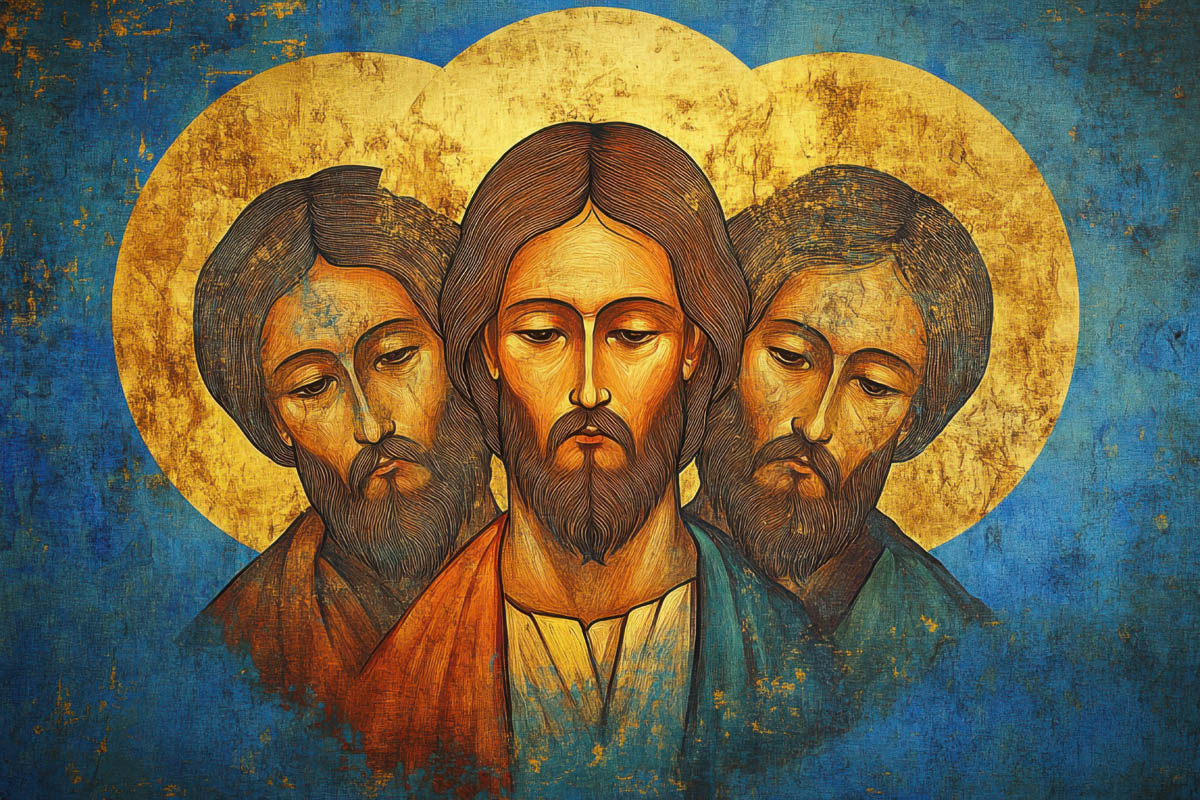
In my last blog, I addressed the question of whether or not Jesus ever talked about the Trinity. And to that very simple question, the unequivocal answer is: No! He never used the word “Trinity” itself. The term “Trinity” only surfaces about two centuries later as shorthand for the Church’s belief that the One God is Three Persons, the Father, Son, and Holy Spirit.
However, I went on to explain that if the question is asked whether or not Jesus ever talked about what the word “Trinity” points to, what it’s meant to refer to in a shorthand way, namely the understanding of God as Three coequal Persons, the Father, the Son, and the Holy Spirit, then the unequivocal answer is: Yes! Jesus definitely did talk about the Trinity.
In fact, in Matthew 28:19, the verse I focused on last week, I used a gospel commentary by John Meier, the first of what I’m calling my “Trinity of Scholars”, to show how Jesus could not have been any clearer about the Trinity, even if He didn’t use that word itself. In Meier’s words, Jesus could not have more “forcefully proclaimed” the understanding of what would later be called the doctrine of the Trinity. Especially given His first-century Jewish context and its understanding of how the Divine Name reveals the Divine Identity, Jesus could not have talked about what we now call the Trinity any more clearly, adamantly, or explicitly. He could not have made the fact that the true identity of God—Who God is in Godself—is comprised of three Divine Persons, precisely what the term “Trinity” denotes.
But I went on to say that it gets even better than this. Because not only do we know that Matthew records Jesus having revealed the Divine Identity to be Trinitarian by commissioning His disciples to baptize new converts in the Name of the Father, and of the Son, and of the Holy Spirit. Not only do we know that the understanding of God as Three Persons is clearly found here in Scripture. But we can actually trace a “Trinitarian” understanding of God back to the Early Church, before the New Testament was even written.
As most critical scholars maintain, the twenty-seven books that make up the New Testament were written somewhere between the late 40’s and 100 AD, the period of about 30 to 70 years after Jesus’ Crucifixion. In the gap between Jesus’ life and the first New Testament books to be written, we have good reason to think that the understanding of God as Triune was already alive and well.
Even if you are skeptical about the accuracy and/or historical reliability of Scripture, scholars can reasonably reconstruct what beliefs those earliest disciples of that first Christian generation must have held in order to produce the developments which we find present in the New Testament. Well before any New Testament book was written, we can establish that the earliest Christians had already come to believe the essence of what Matthew 28:19 would later record Jesus having said about God being Father, Son, and Holy Spirit. (Because far more is said in the New Testament about Jesus, this kind of reconstruction is easier to do with their beliefs about Jesus than with the Holy Spirit. But there is sufficient material relative to the Holy Spirit to provide firm conclusions about the Spirit as well.)
In this blog, I’ll show how this is done. In my next blog, I’ll provide further evidence that not only supports this conclusion, but which also reveals how thoroughly this Trinitarian understanding must have permeated the Early Church.
So let me introduce the second member of what I’m calling my “Trinity of Scholars”, Raymond Brown. Even though Brown passed away a number of years ago, his scholarship still dominates the field. He remains one of the most widely consulted and respected modern critical biblical scholars. Many regard him as the greatest scripture scholar of the last third of the Twentieth Century.
In his monumental two-volume commentary on John’s Gospel, Brown addresses the unique term John regularly uses, and even substitutes for, the Holy Spirit. It is found scattered throughout five passages from the so-called Last Supper Discourse, which dominates the latter part of the Gospel, encompassing chapters 13 through 17. In these sections, as Jesus gives final instructions to His disciples on the night prior to His crucifixion, He reassures them that, even though He is going away, He is going to send them “another Paraclete”.
At first, this figure known as the Paraclete, “Parakletos” in the Greek, seems like a strange, unwarranted intrusion into the text. In the Greek, it’s the combination of two words: “para”, which means to come alongside, and “kalein”, to call. So literally, it means “to call alongside”. Depending on whether it’s in the active or passive moods, it can be translated a number of different ways. That’s why you can find it variously translated as advocate, comforter, intercessor, and/or defense attorney.
But however you translate it, the core idea is the same: Jesus is saying that “I’m going to send another one of me”—by stressing that He is sending them another Paraclete, He implies that He, too, is a Paraclete, one who has been sent by the Father to come alongside the disciples during His time on earth. Now that He is returning to His Father, Jesus is going to send another one, just like Him, identical to Him, who will teach, guide, and stand by the disciples in the same way that He has.
Moreover, the Paraclete He is sending will make everything He has already said to them perfectly clear—the disciples clearly have had a hard time understanding much of it. Indeed, Jesus tells them, just as He only said what He had heard from the Father, so the Paraclete will only be saying what He has heard from the Son. Having the Paraclete will be just as good as if Jesus was there Himself, revealing to them the meaning of things they could not fully understand prior to Jesus’ death and resurrection.
In John 14:26, Jesus identifies the “Parakletos” as the Holy Spirit. So, the Paraclete is clearly the Holy Spirit. But as Brown points out, John depicts Jesus using this term in order to highlight and emphasize one particular aspect of the many roles the Holy Spirit plays throughout the rest of the New Testament. The Paraclete, in other words, is simply the Holy Spirit in a special role—as the One who comes alongside the disciples.
By giving the Holy Spirit this title, John stresses what he sees as the most important role the Holy Spirit has—assuring the disciples that when Jesus returns to the Father, He will not leave them orphaned. They will never be without Jesus because, through the Holy Spirit, both Jesus and the Father will dwell, abide, live within them—and they in God. They will never be alone, because the Paraclete will be with them, making the entire Godhead, as Augustine would say, more intimate to us than we are to ourselves.
That’s the idea behind John using the title Paraclete: It emphasizes the preeminent role John sees the Holy Spirit playing in the disciple’s life, making not only Himself but also the Father and the Son more intimate to the believer than they are to themselves. Through the Paraclete, the believer shares in the eternal love the Father, Son, and Spirit have for one another. The one who receives the Spirit, therefore, participates in the Divine Life. Through the Paraclete, Jesus may no longer be physically present, in human form. However, He is spiritually present through this indwelling.
So what? What does any of this prove?
Well, here’s why that matters so much: Because if you compare John with a number of the other New Testament writings, like Mark’s Gospel, for example; or Matthew’s, and the way the Holy Spirit is depicted therein, including Matthew 28:19; or Luke, both his Gospel and the Acts of the Apostles, which is often referred to as the Gospel of the Holy Spirit because the Spirit emerges as the central character of the narrative, much the same way Jesus does in the Gospels; or if you compare John with Paul, the earliest recorded writings about the Holy Spirit, you will notice that, even though they all share a common understanding of the Spirit, each one of these writers highlights a different aspect of the Spirit’s role. Each uniquely emphasizes or accentuates or focuses on a certain aspect or aspects the Holy Spirit plays which they find most compelling and/or relevant to the audience they are writing to. In much the same way that John does. Although perhaps not as dramatically as John—none other creates a new title for the Spirit the way that John does. But, as Brown demonstrates, just as John is very aware that the Holy Spirit plays many roles in the Early Church but chooses to accentuate and develop His role as Paraclete, each puts their own special emphasis or “spin”, if you will, on the Holy Spirit.
At the same time, it is clear all are working with a more basic, common, prior understanding of the Holy Spirit. This is the raw material each is using to develop in different directions. (Brown provides a complex analysis of the layers of tradition that go back to this very early, foundational understanding that constitutes the raw material they all are clearly working with.) Moreover, the various developments on this theme we find across numerous New Testament books betrays sophisticated, nuanced, and in a number of cases, profound theological reflection.
As Brown, along with many other scholars, would say, the degree of development evident in different New Testament texts that talk about the Spirit takes time. Significant time. Like any creative process, generally the more rarefied a piece of work is, the more time and effort it takes for the artist to perfect it. The extent of development evident in the very different directions numerous New Testament writers take the same raw material betrays a involved process. That is why Brown thinks it took several decades at least for the unique Johannine understanding of the Paraclete to emerge from the inherited tradition about the Holy Spirit.
To get the degree of development we find with the Paraclete in John’s Gospel, to find such a significant expansion of understanding in one particular role of the Holy Spirit, to develop the concepts and find the language to capture and express this special emphasis; to have Paul, as another example, pursuing a parallel process, but in a strikingly different direction, conceptualizing the Spirit taking up residence in the believer the way God’s imminent, felt presence was thought by Jews to take up residence in the Temple sanctuary, that the body of the Christian is the Temple of the Holy Spirit—all of this diverse development requires an intense, sustained, prolonged period of deep, theological reflection. Which, in turn, requires time. A significant amount of time.
It is critical to note that in all of this time-intensive development, there is a core set of shared beliefs about the Holy Spirit—and the Spirit’s relationship to the Father and the Son—that remains. As Brown’s exhaustive analysis shows so clearly, for all their different variations and special emphases, the New Testament writers exhibit a fundamental understanding of the Spirit that undergirds their unique focus. This tells scholars that the fundamental understanding they are working from must have been established quite early, as early as the sources allow us to trace, perhaps very close to the time of Jesus, but certainly well prior to the first New Testament books being written.
What is this fundamental understanding? From the common elements across diverse developments, it must have included a view of the Holy Spirit as a distinct Divine Person equal to God the Father and Jesus the Son. Otherwise, given the very different directions these writings go, we would not expect to find them being so consistent on this point.
Even if the term “Trinity” itself wasn’t being used, the fundamental understanding that undergirds the various lines of development we have so clearly evident in the New Testament texts reveals that, at some point prior to first books of the New Testament being written, the earliest Christians must have embraced an understanding of Holy Spirit as a separate Divine Person, coequal with Jesus and the Father. By the time the New Testament begins to be written, this understanding had to be alive and well among that first generation of Christians in order to produce the kinds of development, with all the similarity and dissimilarity, we find in the New Testament.
It appears then that, as far back as we can trace, the earliest Christians were convinced that they couldn’t speak about God without including Jesus His Son and the Person of Holy Spirit in the same breath, right alongside the Father.
In my next blog, I will not only provide more evidence to corroborate this conclusion, I will also show how widely it was simply presumed to be true by the time the earliest books of the New Testament are written, only twenty years after Jesus’ crucifixion.
But for now, just consider how cool this radical, new understanding of God was—and is. It says that, throughout eternity, before God created any one of us, before there was space and time, the Divine Life consisted in these Three Persons, completely in love with one another. They are the God Who is love, three eternal Divine Persons in a relationship of perfect love. And we can share in this Divine Life through the power and presence of the Holy Spirit. Indeed, this is the very reason God created us.
The coolest thing about this is that it means we are never alone. With the Holy Spirit dwelling in us, we are never alone. For anyone who receives the Spirit, you are never alone. The Creator of all, the Lord of the Universe, the Living God dwells in you and you in His Triune Unity and Love. You are eternally united to the Father, Son, and Holy Spirit in the communion of their perfect love.
And that’s John’s point in giving the Holy Spirit the title “Paraclete”. This is what He does, what He invites us into. You and I can have access to the Divine Life. We can participate in that divine life, albeit imperfectly this side of eternity, through the power of the Holy Spirit. When we put our faith in Christ and receive the Holy Spirit, the entire Trinity comes along side us, to comfort us, defend us, intercede and advocate for us, and, above all, be with us forever more so that we will never, ever be alone again.
I’d love to hear your thoughts on these blogs I’m doing about the Trinity, or any other thoughts you have. You can go to the “Contact E.J.” Page of the Raising Jesus website and leave your comments there. I look forward to hearing from you!
